What Is OCD? Understanding Intrusive Thoughts and the OCD Cycle

Omar Emad · Founder, Oaura
Most people have heard of OCD. Far fewer understand what it actually is.
The popular image — someone who washes their hands a lot or keeps their desk perfectly organized — captures only a thin slice of a condition that affects roughly 1 in 40 people worldwide. Many people with OCD have no visible rituals at all. Their suffering is entirely internal, invisible to everyone around them.
This post is about what OCD actually is, how the cycle that drives it works, and why understanding that cycle is the first step toward breaking it.
The Core of OCD: Not Cleanliness, Not Perfectionism
OCD stands for Obsessive-Compulsive Disorder. At its core, it is defined by two things:
Obsessions — unwanted, intrusive thoughts, images, or urges that are distressing and feel impossible to dismiss.
Compulsions — repetitive behaviors or mental acts performed to reduce the distress caused by obsessions.
The content of obsessions varies widely between people. Common themes include fears of harming oneself or others, fears of contamination, fears of having sinned or acted immorally, fears about relationships, and fears about existential uncertainty. The specific theme matters less than the structure: an intrusive thought arrives, it feels unbearable, and the person does something to make it stop.
That "something" is the compulsion. And compulsions are where most people's understanding of OCD falls apart.
The OCD Cycle
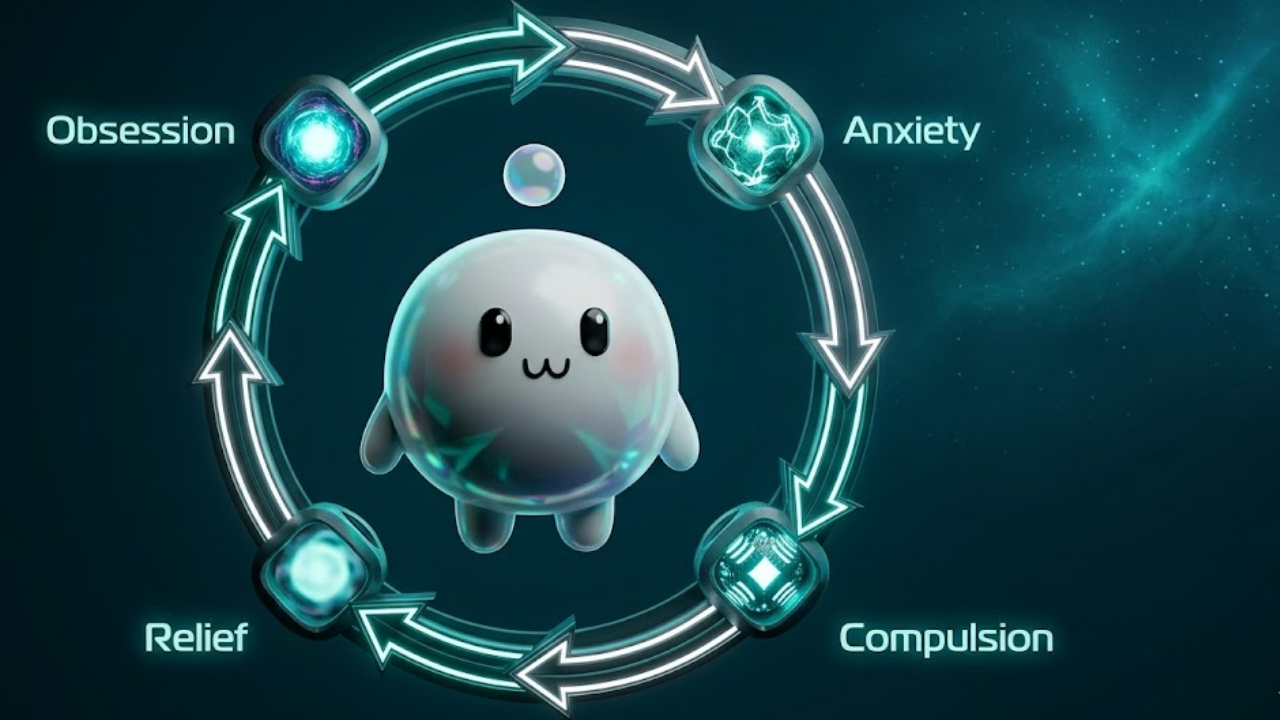
OCD doesn't just appear and disappear. It runs on a loop — a self-reinforcing cycle that grows stronger over time if left untreated.
Here's how it works:
-
Trigger — Something in the environment (or just a random thought) triggers an intrusive thought. Did I leave the stove on? What if I hurt someone I love? What if I don't actually believe what I think I believe?
-
Obsession — The thought sticks. It feels meaningful, urgent, dangerous. The mind assigns it a level of threat far above what the thought deserves.
-
Anxiety — The perceived threat generates real anxiety. The body responds as if danger is present: elevated heart rate, racing mind, a desperate need to resolve the uncertainty.
-
Compulsion — To relieve the anxiety, the person performs a compulsion. This might be a visible behavior (checking, washing, arranging) or a mental act (reviewing, reassuring oneself, seeking reassurance from others, mentally neutralizing the thought).
-
Temporary relief — The anxiety drops. For a moment, it feels like the compulsion worked.
-
The trap — By performing the compulsion, the brain learns that the obsession was a genuine threat worth responding to. The threshold for future anxiety lowers. The obsessions return faster and more intensely. The cycle tightens.
This is the cruel mathematics of OCD. Every compulsion that brings relief makes the next obsession more powerful.
Why "Just Stop Thinking About It" Doesn't Work
When people tell someone with OCD to "just ignore the thoughts," they're suggesting the exact opposite of what the person has been trying to do. People with OCD are experts at trying to suppress their intrusive thoughts. The problem is that thought suppression doesn't work — it makes the thoughts come back stronger.
This is sometimes called the white bear effect, after a famous psychology experiment. When participants were told not to think about a white bear, the white bear became impossible to stop thinking about.
OCD exploits this mechanism. The more someone fights an intrusive thought, the more mental real estate it occupies. The solution is not better suppression — it is a fundamentally different relationship with the thoughts.
What Actually Helps: ERP
The gold-standard treatment for OCD is Exposure and Response Prevention (ERP), a form of Cognitive Behavioral Therapy specifically designed for the OCD cycle.
The logic of ERP is the inverse of the compulsion cycle:
- Exposure — Deliberately encounter the feared thought, situation, or stimulus without avoiding it.
- Response Prevention — Resist the urge to perform the compulsion.
By sitting with the anxiety without responding to it, the brain learns something new: the obsession does not require action. The anxiety, uncomfortable as it is, will peak and then fall on its own. Over time, the threat-response to the intrusive thought weakens. The thought loses its power.
ERP is not easy. It requires tolerating real distress in the short term to break the cycle in the long term. But the evidence behind it is extensive — most people who complete an adequate course of ERP experience significant symptom reduction.
OCD Is Not a Character Flaw
One of the most damaging misconceptions about OCD is that intrusive thoughts reflect who the person really is. They don't.
Everyone has intrusive thoughts. Research shows that over 90% of people occasionally experience thoughts about harm, taboo topics, or disturbing scenarios. In most people, these thoughts pass quickly and are forgotten. In people with OCD, the brain mislabels them as signals of danger or moral failure, triggering the anxiety-compulsion cycle.
Having an intrusive thought about harm does not make someone dangerous. Having an intrusive thought about a taboo topic does not make someone morally corrupt. OCD is a misfiring alarm system — loud, convincing, and completely unreliable.
The First Step
If you recognize yourself in this description — the cycle of intrusive thoughts, the compulsions that bring temporary relief, the way the anxiety keeps returning stronger — you're not alone, and you're not broken.
OCD is one of the most treatable mental health conditions when addressed with the right approach. Understanding the cycle you're in is the first step toward learning to step outside of it.
That's what Oaura is built to help you do — evidence-based support for OCD recovery, available whenever you need it.
This article is for informational purposes only and is not a substitute for professional medical advice.
Omar Emad· Founder, Oaura
Building accessible OCD support with AI. Passionate about making evidence-based help available to everyone who needs it — not just those who can afford it.